Intermittent claudication
Peripheral arterial disease
The progressive narrowing and blockage of the leg arteries due to atherosclerosis. Its typical symptom is intermittent claudication: calf pain when walking that forces you to stop and disappears after resting for a few minutes.
A common and often silent disease
It affects hundreds of millions of people worldwide, but many have no symptoms or put them down to age. Detecting it matters for two reasons: the leg and, above all, the heart and brain, because these patients have a high risk of heart attack and stroke.
Stages of the disease
- No symptoms: discovered through an abnormal ankle-brachial index or weak pulses.
- Intermittent claudication: muscle pain after walking a certain distance, which eases at rest.
- Chronic limb-threatening ischaemia: pain at rest, especially at night in bed, and wounds or gangrene on the feet. Requires urgent treatment to avoid amputation.
A foot that suddenly becomes cold, pale, painful and weak is an emergency (acute ischaemia): go to A&E immediately or call 112.
Diagnosis
- Ankle-brachial index (ABI): compares blood pressure at the ankle with that in the arm. A value outside the normal range (0.91–1.39) indicates arterial disease. In people with diabetes or kidney disease, whose arteries may be calcified, the toe-brachial index is used.
- Arterial duplex ultrasound: locates narrowings and blockages.
- CT or MR angiography: when revascularisation is being considered.
The 2024 European guidelines suggest measuring the ABI in people aged 65 or over, and in those aged 50 to 64 with risk factors such as smoking, diabetes, high blood pressure, high cholesterol or kidney disease.
Treatment
1. Protect the heart and brain
- Stop smoking completely: the most effective measure.
- Statins for cholesterol, which also improve walking distance.
- Antiplatelet drugs when there are symptoms or after revascularisation.
- Good control of blood pressure and diabetes.
2. Walk more: supervised exercise
The European guidelines establish supervised exercise as the first-line treatment for claudication: walking regularly until moderate pain appears, resting and repeating, several times a week, increases the distance you can walk without pain and improves quality of life.
3. Revascularisation
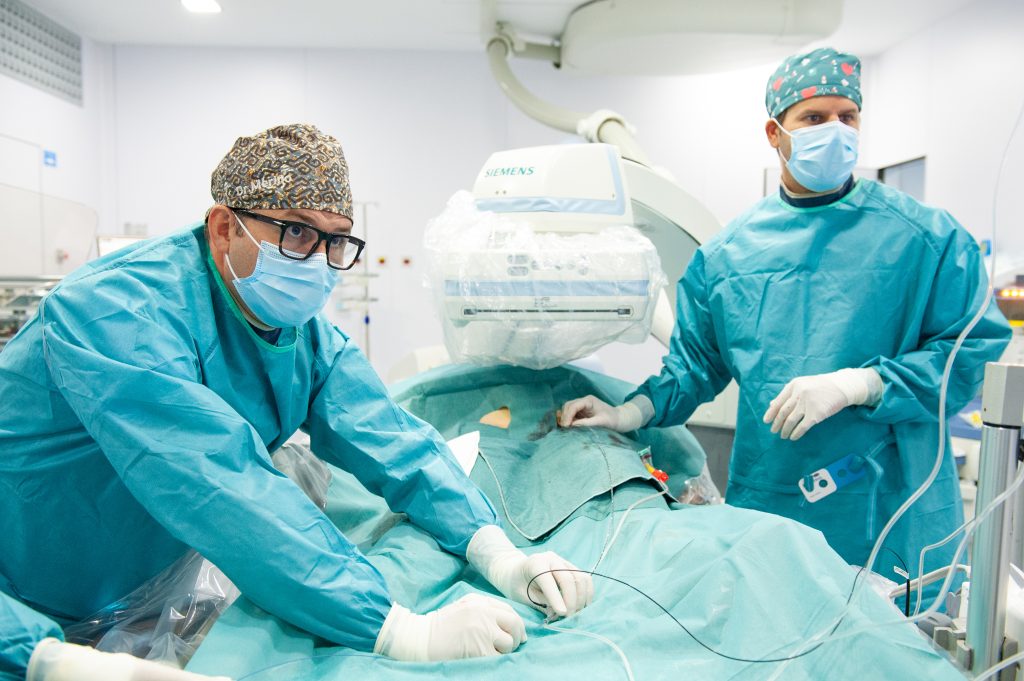
This is considered when claudication severely limits daily life despite medical treatment and exercise, and always in limb-threatening ischaemia. It can be endovascular (balloon angioplasty and stents through a puncture) or surgical (bypass using the patient’s own vein or a prosthetic graft, and endarterectomy). Continuing exercise is also recommended after revascularisation.
Videos on this topic (in Spanish)


References
- Nordanstig J, Behrendt CA, Baumgartner I, et al. European Society for Vascular Surgery (ESVS) 2024 Clinical Practice Guidelines on the Management of Asymptomatic Lower Limb Peripheral Arterial Disease and Intermittent Claudication. Eur J Vasc Endovasc Surg. 2024;67(1):9-96.
Patient information reviewed by Dr Óscar Merino, vascular surgeon. It does not replace an individual medical assessment.
Do your legs hurt when you walk?
Consultation with duplex ultrasound at Clínica Rotger, in the centre of Palma.
Follow me
Weekly tips on circulation and vascular health (in Spanish).