Pelvic venous disease in men
Varicocele
A varicocele is a dilatation of the veins that drain the testicle, almost always on the left side. It is the male equivalent of pelvic varicose veins and, in most cases, it can be treated without surgery by embolisation.
Is it common?
Very. It is found in 10–20% of men and is typically left-sided: in a series of 225 treated patients, 97% had it on that side. It is also more common in men with fertility problems: it is found in around 40% of men seeking help for primary infertility and in 80% of those with secondary infertility.
Why does it happen?
- Reflux: the valves of the left gonadal (testicular) vein do not close properly and blood flows back towards the scrotum. This vein drains at a right angle into the left renal vein, which explains why the left side is most often affected.
- Compression: in some men the cause is Nutcracker syndrome. The left renal vein is compressed and blood escapes through the gonadal vein, which becomes dilated.
A varicocele that is only on the right, or that appears suddenly in an adult, requires other abdominal causes to be ruled out.
Symptoms
- Often none: it is discovered at a check-up or during fertility investigations.
- Heaviness or a dull ache in the testicle that worsens when standing, with exertion and at the end of the day, and improves when lying down.
- A soft lump above the testicle, sometimes compared to a “bag of worms”.
- Abnormal semen analysis or difficulty conceiving.
- In adolescents, one testicle smaller than the other.
Diagnosis
- Examination standing up and with the Valsalva manoeuvre (bearing down as if straining).
- Scrotal duplex ultrasound: confirms the dilated veins and the reflux.
- Semen analysis and assessment by urology or andrology when fertility is a concern.
- If renal vein compression is suspected, abdominal duplex ultrasound and CT or MR angiography.
When is it treated?
Not every varicocele needs treatment. Treatment is considered when it causes pain that does not improve with simple measures, when there is infertility with abnormal semen analysis or, in adolescents, when the affected testicle stops growing. The decision is made together with urology.
Treatment: embolisation without surgery
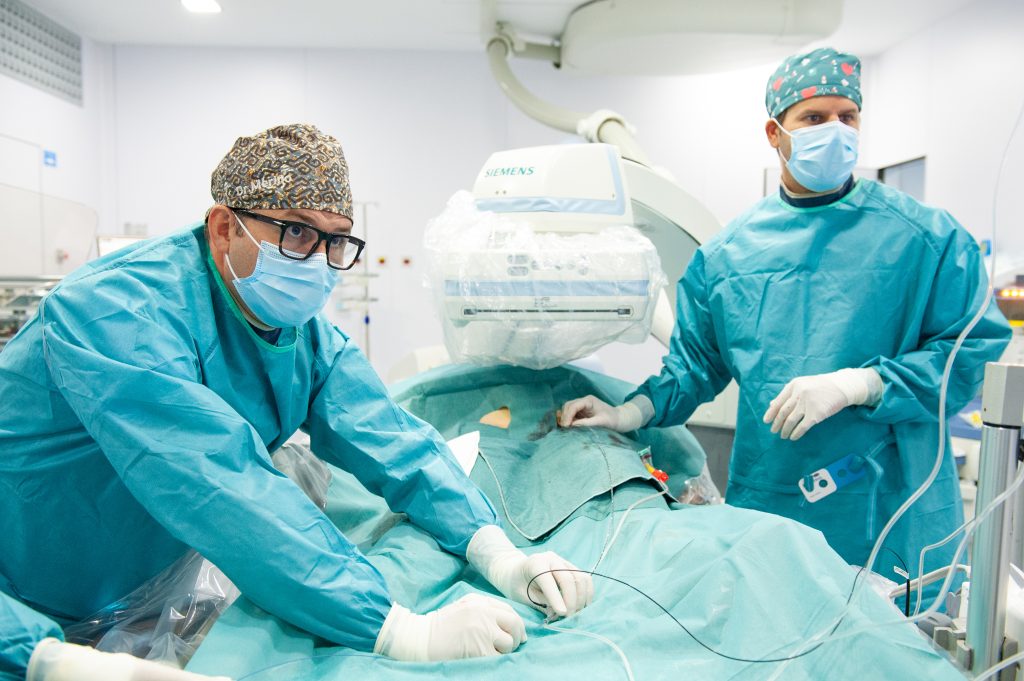
Through a needle puncture in a vein (in the neck, arm or groin) and under local anaesthesia, a catheter is guided to the gonadal vein, which is closed from the inside with coils or a sclerosing agent. There are no incisions in the scrotum and recovery is quick.
In a series of 225 men treated over fifteen years, embolisation was technically successful in 96% of cases, complications occurred in 1.8%, none of them serious, and recurrence confirmed by ultrasound was 6% among patients with follow-up. Embolisation is also a good option when a varicocele recurs after surgery.
If the varicocele is caused by renal vein compression (Nutcracker), treatment is planned differently, because the gonadal vein is acting as an escape route. That is why the whole venous system should be assessed before treatment.
Frequently asked questions
Does varicocele affect fertility?
It is more common in men with infertility and can affect semen quality, but many men with a varicocele are fertile. That is why treatment for fertility reasons is decided on the basis of semen analysis and together with urology.
Can it be treated without an operation?
Yes. Embolisation is performed through a vein puncture under local anaesthesia, without any incisions in the scrotum.
Can it come back?
Yes, in a small percentage of cases, both after embolisation and after surgery. If it recurs, it can usually be treated again by the endovascular route.
Is it related to Nutcracker syndrome?
In some men, yes: compression of the left renal vein hinders drainage and blood escapes through the testicular vein. In these cases the cause must be investigated and treated.
References
- de Grae MNM, Al-khattab M, Alkadhimi A, et al. A fifteen-year retrospective analysis of varicocele embolization: evaluating success, recurrence rates and embolic agents. CVIR Endovasc. 2025;8:59.
- Ramasamy R. Percutaneous embolization: a viable treatment option for varicocele. Basic Clin Androl. 2014;24:10.
- Ananthan K, Onida S, Davies AH. Nutcracker syndrome: an update on current diagnostic criteria and management guidelines. Eur J Vasc Endovasc Surg. 2017;53(6):886-894.
Patient information reviewed by Dr Óscar Merino, vascular surgeon. It does not replace an individual medical assessment.
Would you like an assessment?
Consultation with duplex ultrasound at Clínica Rotger, in the centre of Palma.
Do you live outside Mallorca?
Send me your test results: I review them in advance and we hold a first video consultation. If treatment is needed, we coordinate the whole process.
Follow me
Weekly tips on circulation and vascular health (in Spanish).