Area of special focus
Pelvic congestion and vascular compression syndromes
Pelvic congestion and vascular compression syndromes are little-known conditions that often go undiagnosed for years. They require specific investigations and advanced endovascular techniques, and they are one of the areas to which I devote most time, both in clinic and in training other specialists.
What are they?
They bring together two types of problem that often occur together:
- Pelvic venous insufficiency: the veins of the pelvis (ovarian, internal iliac or, in men, those of the spermatic cord) lose their valves and become dilated. This causes pelvic congestion syndrome in women and varicocele in men.
- Compression syndromes: a vein, an artery or a nerve becomes trapped between structures of the body itself (another artery, the spine, a ligament, a rib or a muscle). They are not related to tumours.
The two can be connected: when a vein in the abdomen is compressed, blood seeks alternative routes through the pelvis and pelvic, vulval or scrotal varicose veins appear. That is why I always assess the entire venous system, from the renal vein down to the legs.
Conditions I treat
Pelvic congestion syndromeChronic pelvic pain caused by varicose veins of the ovarian and pelvic veins, especially after pregnancy.
VaricoceleVaricose veins in the scrotum. It can cause pain and affect fertility.
May-Thurner syndromeCompression of the left iliac vein. Leg swelling, thrombosis and pelvic congestion.
Nutcracker syndromeThe left renal vein is trapped between the aorta and the superior mesenteric artery.
Wilkie syndromeThe same arterial pincer compresses the duodenum. It sometimes coexists with Nutcracker syndrome.
Median arcuate ligament syndromeCompression of the coeliac trunk by the diaphragm. Abdominal pain after eating.
Thoracic outlet syndromeCompression of the vein, artery or nerves of the arm. Includes effort thrombosis (Paget-Schroetter syndrome).
Popliteal artery entrapmentCompression of the artery behind the knee. Calf pain during exercise in young people.
Why they take so long to diagnose
Their symptoms are non-specific (pelvic pain, low back pain, abdominal pain after eating, a swollen leg, tingling in the arm) and resemble those of much more common conditions. Many patients have first been seen by gynaecology, urology, gastroenterology or orthopaedics. In addition, conventional imaging is performed lying down and at rest, precisely when these compressions are least evident.
The opposite challenge is just as important: a compression on a scan is not always a disease. In a classic CT study of 50 people seen in the emergency department for other reasons, 24% had the left iliac vein compressed by more than 50% without any symptoms. Treating on the basis of imaging alone exposes patients to unnecessary risks; what matters is whether the compression genuinely alters blood flow and explains the symptoms.
How I investigate them
- A focused clinical history and review of all previous tests. For pelvic disease I use the SVP classification (symptoms, varices and pathophysiology), which structures both investigation and treatment.
- Duplex ultrasound of the abdomen, pelvis and legs, with manoeuvres and changes of position when needed.
- CT or MR angiography to see the complete anatomy and measure the compressions.
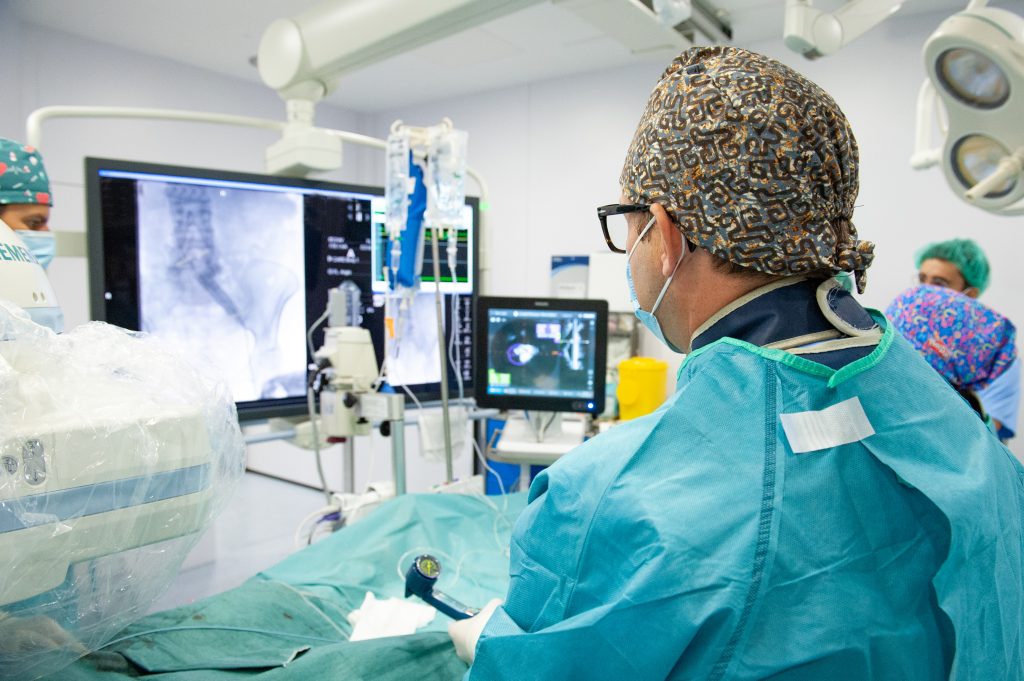
- Venography with intravascular ultrasound (IVUS): a catheter with an ultrasound probe at its tip measures the compression from inside the vessel. At Clínica Rotger we have the Philips IntraSight system. The multicentre VIDIO study showed that IVUS detects and quantifies these lesions better than venography alone.
- Multidisciplinary assessment with gynaecology, urology, gastroenterology, general surgery, radiology or rehabilitation, depending on the case.
Treatments
Pelvic vein embolisationThe diseased pelvic or gonadal veins are closed from the inside with coils, foam or plugs, through a vein puncture under local anaesthesia.
IVUS-guided venous stentingKeeps the compressed vein (iliac or renal) open. IVUS allows the exact size and position to be chosen.
Hybrid surgery for Nutcracker syndromeA stent that is not oversized, fixed to the vein through a small incision, as a less invasive alternative to bypass.
Decompression surgeryRelease of the median arcuate ligament, first rib resection for thoracic outlet syndrome or release of the popliteal artery.
In non-thrombotic venous compressions, a meta-analysis of 37 studies and 2,869 patients found that 96% of stents were still open at one year, with few serious complications. In pelvic congestion, a systematic review of 1,308 women reported significant pain relief in around 75% after embolisation. Every indication is decided individually, and many patients improve with conservative measures.
Experience and training
- Organiser and director of the Clínica Rotger workshops on the diagnosis and treatment of abdominal and pelvic venous disease, which train other specialists: five editions since 2025. The sixth will take place in February 2027 and the seventh, also in 2027, will be international.
- Speaker on venous compression syndromes and current treatment strategies at the 16th Mediterranean Symposium of Vascular Surgery (Valencian Society of Angiology and Vascular Surgery, 2025).
- Speaker at the Venous Summit of the Endovascular Surgery Chapter of the Spanish Society of Angiology and Vascular Surgery (2023 and 2024).
- Continuing training in pelvic vein embolisation, IVUS-guided venous stenting and vena cava reconstruction at Hospital Quirónsalud Málaga (2024).
You can find the rest of my career in publications, lectures and congresses.
If you live outside Mallorca
I see patients from the other Balearic Islands, mainland Spain and abroad. To make the journey worthwhile, the process starts before you travel:
- Send me your test results: reports and, if possible, the CT, MRI or ultrasound images. For information, call +34 971 448 500.
- I review them before the consultation, to assess whether the compression or the varicose veins explain your symptoms.
- We hold a video consultation to discuss the findings and answer your questions.
- If treatment is needed, we coordinate the whole process (tests, dates and hospital stay) with your comfort and safety as the priority.
Frequently asked questions
Which specialist treats pelvic congestion and compression syndromes?
A vascular surgeon, because these are diseases of the veins and arteries and most are treated with endovascular techniques or vascular surgery. In many cases we work together with gynaecology, urology, gastroenterology or general surgery.
A compression was seen on my CT scan. Do I need treatment?
Not necessarily. These compressions are common in people without symptoms. They are only treated when they alter blood flow and explain your symptoms, which is confirmed with specific investigations.
Does embolisation of pelvic varicose veins affect fertility or periods?
In the reference systematic review of 1,308 women, no negative effects on menstruation or fertility were observed, although the authors note that the quality of the evidence is low.
Will I need to stay in hospital?
It depends on the procedure. Embolisation and venous stenting are performed through a needle puncture, without incisions, and the stay is usually short; decompression surgery requires a somewhat longer admission. In the consultation I will explain what to expect in your case.
Can I be treated if I live in another region or country?
Yes. I review your tests in advance, we hold a video consultation and, if treatment is needed, we coordinate the whole process so that you have to travel as little as possible.
Videos on this topic (in Spanish)


References
- De Maeseneer MG, Kakkos SK, Aherne T, et al. European Society for Vascular Surgery (ESVS) 2022 Clinical Practice Guidelines on the Management of Chronic Venous Disease of the Lower Limbs. Eur J Vasc Endovasc Surg. 2022;63(2):184-267.
- Meissner MH, Khilnani NM, Labropoulos N, et al. The Symptoms-Varices-Pathophysiology classification of pelvic venous disorders: a report of the American Vein & Lymphatic Society International Working Group on Pelvic Venous Disorders. J Vasc Surg Venous Lymphat Disord. 2021;9(3):568-584.
- Kibbe MR, Ujiki M, Goodwin AL, Eskandari M, Yao J, Matsumura J. Iliac vein compression in an asymptomatic patient population. J Vasc Surg. 2004;39(5):937-943.
- Gagne PJ, Tahara RW, Fastabend CP, et al. Venography versus intravascular ultrasound for diagnosing and treating iliofemoral vein obstruction. J Vasc Surg Venous Lymphat Disord. 2017;5(5):678-687.
- Razavi MK, Jaff MR, Miller LE. Safety and effectiveness of stent placement for iliofemoral venous outflow obstruction: systematic review and meta-analysis. Circ Cardiovasc Interv. 2015;8(10):e002772.
- Daniels JP, Champaneria R, Shah L, Gupta JK, Birch J, Moss JG. Effectiveness of embolization or sclerotherapy of pelvic veins for reducing chronic pelvic pain: a systematic review. J Vasc Interv Radiol. 2016;27(10):1478-1486.
- Ananthan K, Onida S, Davies AH. Nutcracker syndrome: an update on current diagnostic criteria and management guidelines. Eur J Vasc Endovasc Surg. 2017;53(6):886-894.
Patient information reviewed by Dr Óscar Merino, vascular surgeon. It does not replace an individual medical assessment.
Would you like an assessment?
Comprehensive assessment of pelvic venous disease and compression syndromes at Clínica Rotger, Palma.
Do you live outside Mallorca?
Send me your test results: I review them in advance and we hold a first video consultation. If treatment is needed, we coordinate the whole process.
Follow me
Weekly tips on circulation and vascular health (in Spanish).